
AI agents
AI agents that do the job, not just the demo
An AI agent reads a situation, works out what needs doing, and either does it or asks. We build them for Yorkshire businesses to take on the routine decisions that currently eat a person’s morning, with a human kept exactly where the consequences are.

What it is
In plain English
The difference between an automation and an agent is judgement. An automation does the same thing every time. An agent looks at what’s in front of it, decides what it is and what to do, and handles the ordinary cases itself. The unusual ones it hands to a person with a summary of what it found.
That makes agents the right tool for the jobs that were never quite regular enough to automate the old way: the shared inbox, the enquiry that could be any of six things, the invoice that doesn’t match the order, the support ticket that’s a complaint in disguise.
We build them on the current frontier models, connected to the systems you already run, with the approval steps designed in from the start rather than bolted on after the first mistake. We’ve written honestly about what agents can and can’t do yet, and we build to that evidence, not to the sales pitch.
Good for
The jobs it's built for
-
Inbox triage
Reads every incoming email, works out what it is, logs it where it belongs and drafts the reply for someone to check.
-
Quoting assistant
Pulls the specification out of an enquiry, matches it against past jobs and your price book, and produces a draft estimate with its working shown.
-
Support agent
Answers the routine majority of tickets from your own documentation, escalates early when it’s out of its depth, and never guesses.
-
Document processing
Reads invoices, delivery notes, applications and forms, extracts the facts, checks them against your records and flags what doesn’t add up.
-
Onboarding
Takes a signed engagement or order and does the setup across every system it touches, pausing only where a person genuinely needs to decide.
-
Credit control
Watches the ledger, sends the polite nudges, reads the replies and routes the awkward ones to a human with the account history attached.
When we'd say no
What it isn't for
We won’t build an agent that acts unsupervised on money, legal commitments or personal data. Not because it can’t be done, but because the evidence says it goes wrong, and when it does the cost lands on you. Those jobs get an approval step, and we design the approval so it stays real rather than becoming a button someone clicks four hundred times a day.
And if your job is actually a fixed sequence with no decisions in it, you don’t need an agent. You need a workflow automation, which is cheaper and more predictable. We’ll say so.
Cost and timescale
What it costs
An agent with human sign-off typically runs from around £6,000 to £25,000 to build, depending on how many systems it touches and how much judgement it needs to exercise. Running costs are modest: model usage is usually pennies per item, plus tool subscriptions. We’ve set out the full picture in what AI automation actually costs.
Most agents are live within four to eight weeks. We start at the “advise” level, where the agent drafts and a person acts, and move to approval-based action once you’ve watched it be right for a few weeks and know what its mistakes look like.
Where we work
AI agents across Yorkshire
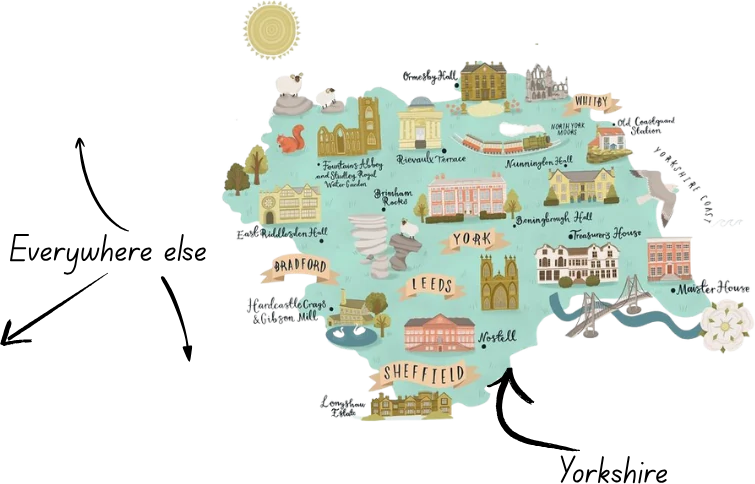
We build AI agents for businesses across Yorkshire: quoting assistants for engineering firms in Sheffield and Rotherham, enquiry handling for professional services in Leeds, document processing for logistics operators around Wakefield and Doncaster, and support agents for growing firms in Bradford, Huddersfield and York. We’re based in the county and happy to come and watch how the job actually gets done before we build anything.
Questions we get asked
Straight answers
What’s the difference between an AI agent and a chatbot?
A chatbot talks. An agent acts. A chatbot answers a question on your website; an agent reads the enquiry, checks your stock system, drafts the quote and books it into the CRM. Most businesses asking for a chatbot actually want an agent behind the scenes, and the chatbot is the last thing we’d build, not the first.
Will the agent make mistakes?
Yes. Every AI system is wrong some of the time, and anyone who tells you otherwise is selling something. The design question is whether the system assumes that. Ours do: clear cases are handled, unclear ones go to a person, and every action is logged so you can see what it did and why.
Can it work with our old software that has no API?
Usually. Agents can now operate software by looking at the screen and using a mouse and keyboard, which opens up council portals, supplier extranets and desktop systems from 2011. It’s slower to build and a bit more fragile to run than a proper integration, so we’ll tell you where it moves the price.
Where does our data go?
Through the AI provider we agree on, under business terms that don’t use your data for training, and stored in your own accounts. We’ll write down exactly which providers see what. If you’re in care, legal, health or finance we’ll talk about keeping more of it on infrastructure you control.
Who owns the agent at the end?
You do. It’s built in your accounts, with your logins, and you can revoke our access the day you decide to. We’d rather you stayed because it works than because you can’t leave.
Proof, not promises
Things we've built like this


Next step
Got a job in this shape?
Tell us what's eating your week. You'll get an honest view on whether this is the right fix, what it would cost, and when it isn't worth doing. Half an hour, no obligation, no sales script.
Worth a read
Before you decide

What AI agents can actually do (and what they can't yet)
On a benchmark of real business workflows, the leading AI models finish well under half of them unaided. Here's what that means if you're thinking of handing work to an agent.
Read it
Seven jobs an AI agent can do for a Yorkshire business
From Sheffield engineering firms to Bradford care providers and Leeds professional services: the everyday jobs AI agents are actually good at, and the ones to leave alone.
Read it
What AI automation actually costs a UK small business
Honest price ranges for workflow automation, AI agents and bespoke AI software from a Yorkshire firm that builds them, plus the running costs nobody mentions in the pitch.
Read it